Your Lift Station Is Working Right Now. Here Is What Happens When It Stops.
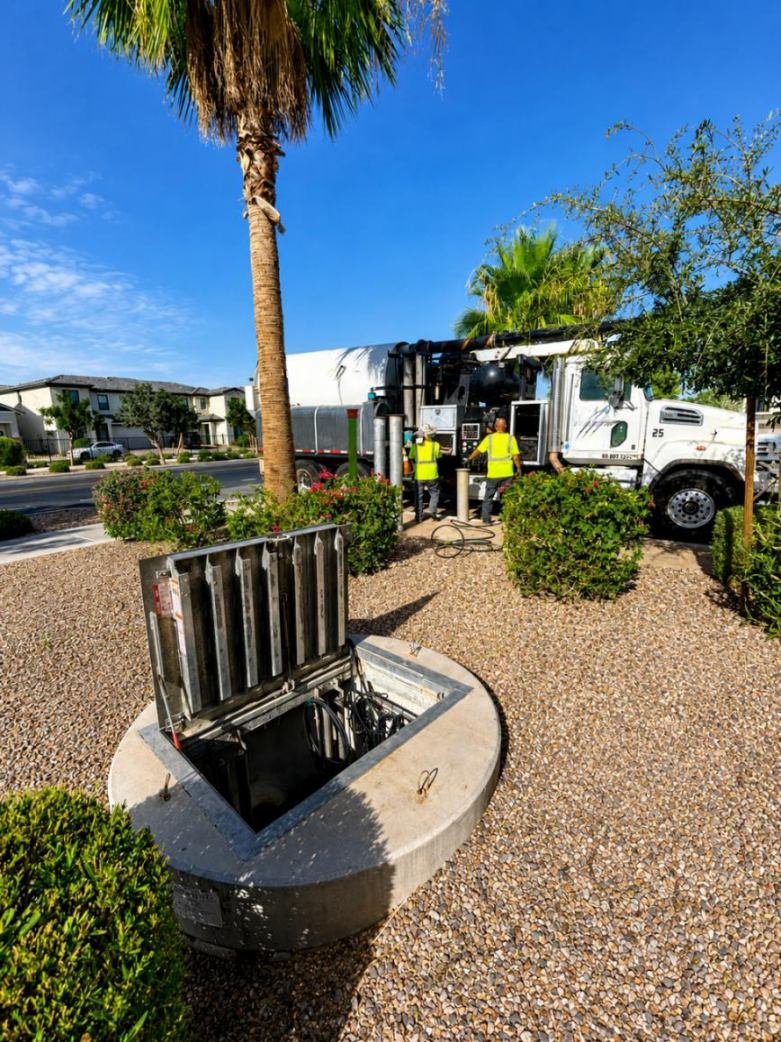
Most people who live near a lift station do not know it is there. It sits in the ground, usually tucked into a landscaped area or behind a fence, doing a job that nobody thinks about until it fails. And when it fails, it fails loud. Sewage backing up into the nearest low point. Alarms going off. Calls coming in from residents or tenants. A situation that needs to be handled immediately and that nobody wants to be managing for the first time without a plan.
We have been in the wet well on jobs that looked like what you see in these photos. A technician leaning over the hatch, equipment being lowered down into standing wastewater, a vac truck staged out front pulling accumulated debris and solids that had been building up longer than anyone realized. That kind of work is not comfortable. It is also not optional.
A lift station that is not maintained on a schedule will eventually fail. The question for HOAs, property managers, and commercial operators is whether that failure happens on your terms or the station's.
What a Lift Station Actually Does
In areas where gravity alone cannot move wastewater from a development to the main sewer line, a lift station handles the job mechanically. Wastewater flows into a below-grade wet well, submersible pumps activate when the water level reaches a set point, and the pumps push the waste uphill or across a distance to where gravity can take over again.
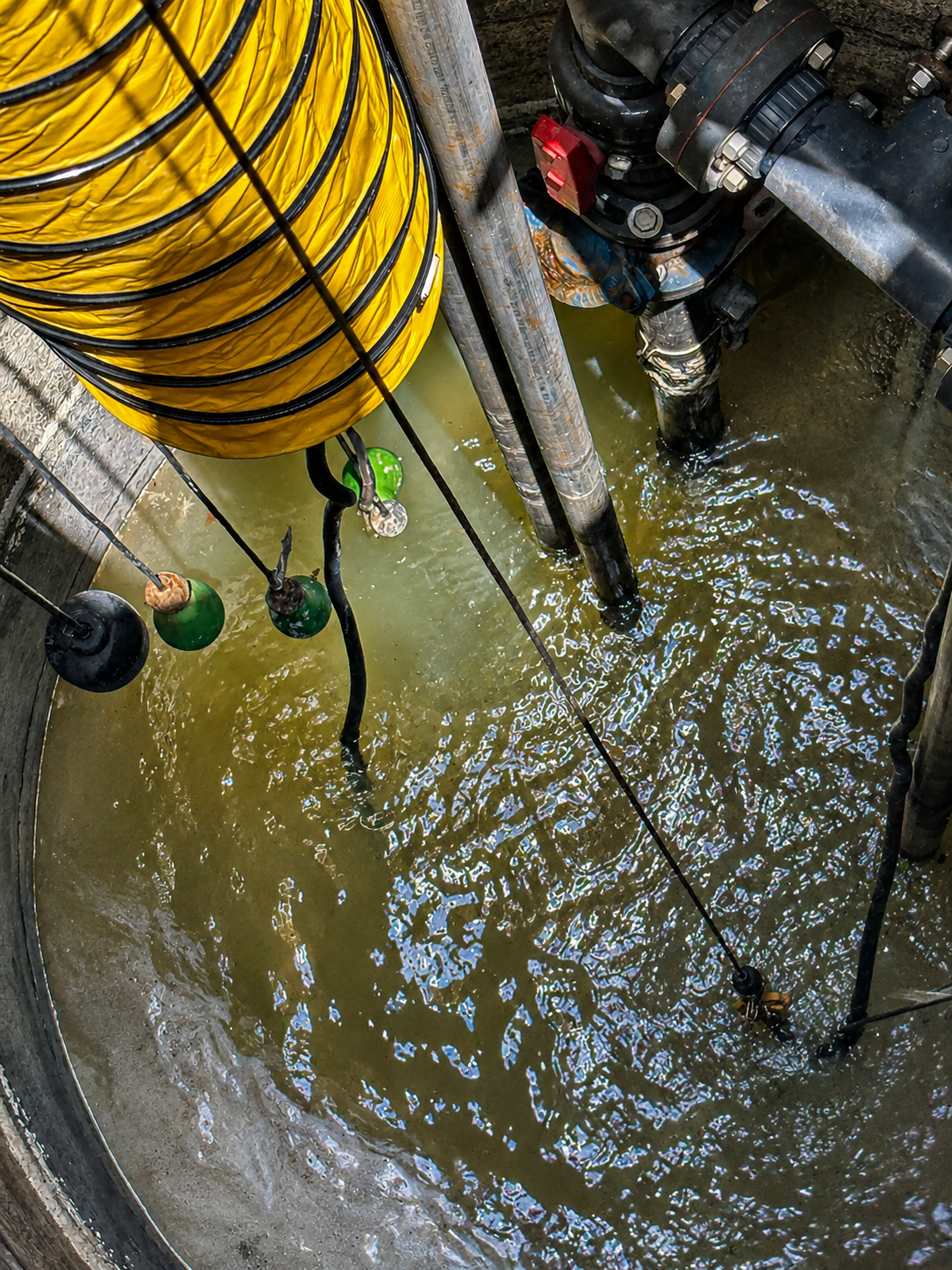
The wet well is the chamber everything flows into. It is a confined space, typically several feet deep, and it collects not just liquid waste but whatever comes with it. Rags, grease, wipes labeled as flushable that are not, grit, sand, and solids of all kinds. Over time, that material accumulates on the wet well floor and on the walls, it coats the float switches that tell the pumps when to run, and it builds up around the pump intakes.
A wet well that has not been cleaned in a year or two looks like the one in the second photo. Standing water with debris floating in it, equipment partially submerged, float switches that may or may not be reading water levels accurately because they are coated or tangled in material. The pumps are still running, probably, but they are working harder than they should be and the readings that tell the system when to activate are becoming less reliable.
What Happens When Maintenance Gets Skipped
Float switches are the first thing to go wrong in a neglected wet well. They are set to trigger the pumps at specific water levels. When they are coated in grease and debris, they stop reading accurately. The pumps may run too late, allowing the wet well to overfill, or they may not trigger at all if the float is stuck in a position that tells the system the level is lower than it actually is.
When a pump does not activate and the wet well fills past capacity, the wastewater has to go somewhere. It finds the lowest accessible point in the system, which is often the cleanout nearest to the lift station, a basement drain, or a low-lying fixture in the closest connected building. A sewage overflow from a failed lift station is not a plumbing problem. It is a health event, a liability event, and depending on the property type, potentially a regulatory event.
Pump motors themselves fail faster in wet wells that are not maintained. Running against accumulated solids at the intake, running hotter because the cooling that comes from clean water flow is reduced, cycling more frequently because the float switches are inaccurate. All of it accelerates wear on equipment that is not cheap to replace.
The vac truck staged in the third photo is doing the job that prevents all of that. Pulling the accumulated waste and solids out of the wet well, cleaning the walls and floor, clearing the float switches so they can read accurately again, inspecting the pumps and the discharge lines while access is open. That visit, done on a regular schedule, is what keeps the station running the way it is supposed to.
Storm Drain Cleaning: The Other System Nobody Watches
Storm drains and catch basins operate on a similar principle of benign neglect. They sit in parking lots, along curbs, and in landscaped areas, and they collect whatever the rain and surface runoff brings. In the Chandler area, that means silt, caliche dust, plant debris, and the accumulated grit from months of dry weather concentrated into the first significant rain event of the season.
A storm drain that is partially or fully blocked does not drain during a rain event. The surface floods. Parking lots pond. Entrances to buildings become impassable. In extreme cases, water finds its way into structures that it should never reach.
The issue is that storm drain blockages develop slowly and invisibly. The drain looks fine from the surface. The basin below it is filling with sediment, debris is accumulating at the inlet, and the pipe leading out from the basin may have root intrusion or a partial collapse that nobody has seen because nobody has looked.
A vac truck can pull the accumulated material from a catch basin in a single visit, inspect the condition of the basin walls and the outlet pipe, and restore full drainage capacity. Done before monsoon season in Chandler, it means the drainage system is actually functional when the first significant storm of the season hits rather than finding out during the storm that it is not.
Who Needs to Be Thinking About This
HOAs with shared infrastructure are the most common situation we see. A lift station serving a residential development is common in neighborhoods built on terrain that does not allow for full gravity sewer. The HOA owns and is responsible for that station, and the maintenance obligation does not go away because nobody on the board is a plumber.
Property managers overseeing commercial or multi-unit properties face the same situation. A lift station failure on a property you manage creates tenant impact, potential liability, and the kind of emergency call that happens at the worst possible time. A catch basin that floods a parking lot during a client visit is a different kind of problem than a slow drain in a single unit.
Restaurants and commercial kitchens that have grease interceptors connected to a shared system also need regular service. Grease that makes it past an interceptor into a lift station wet well is one of the fastest ways to accelerate the problems described above.
What a Scheduled Service Visit Covers
We deploy a vac truck and a crew to the site. The wet well hatch comes open, the space gets assessed before anyone goes near it because confined space entry around wastewater requires specific safety protocols, and the accumulated material gets pulled from the wet well using vacuum equipment.
Float switches get inspected, cleaned, and tested. Pump intakes get cleared. We check the discharge line for any backpressure that might indicate a downstream issue. The wet well walls and floor get cleaned. If there is visible damage to the wet well structure or any equipment concern we can see during the service, we document it and bring it to the property owner or manager before the visit is closed out.
Storm drain service follows a similar process. The basin gets vacuumed, the inlet and outlet get inspected, the condition of the basin is assessed, and anything that is developing into a problem gets flagged while we are there rather than left for the next service visit or the next time something backs up.
If You Manage a Property With This Infrastructure
The first question is usually how long it has been since the last service. If the answer is more than a year, or if nobody is certain when the last visit was, that is where to start. The second question is whether there is a maintenance schedule in place, because a one-time service call without a follow-up plan puts the station back on a path toward the same situation.
We set up maintenance schedules for lift stations and storm drain systems based on the size of the installation, the volume it handles, and the service history. Regular scheduled visits cost significantly less than emergency response calls and the equipment replacements that follow deferred maintenance.
Call us at 480-869-6952 or reach out online. We handle lift station and storm drain service for HOAs, property managers, and commercial operators across Chandler. Pricing is discussed before any work begins.