Your Cold Water Line Is the One Pipe Nobody Thinks About Until It Fails. Here Is What Replacing It Actually Involves.
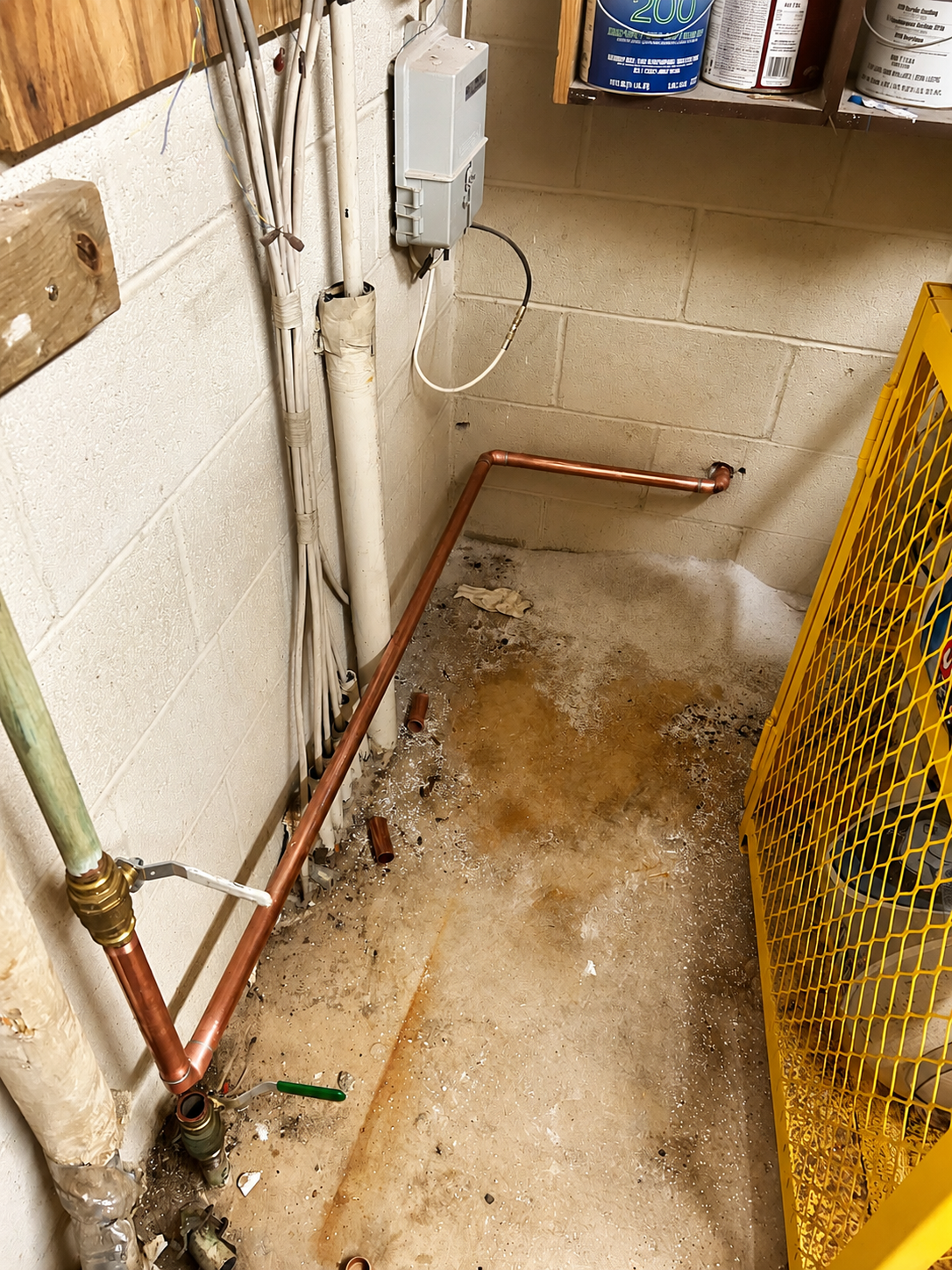
The second photo in this post is from inside a utility room we were called out to in Chandler. Water on the concrete floor, old copper pipe showing its age at the connections, the kind of space that tells you immediately that something had been going wrong for a while before anyone saw it. The cold water supply line coming into that building had failed where the pipe transitioned from underground to the interior.
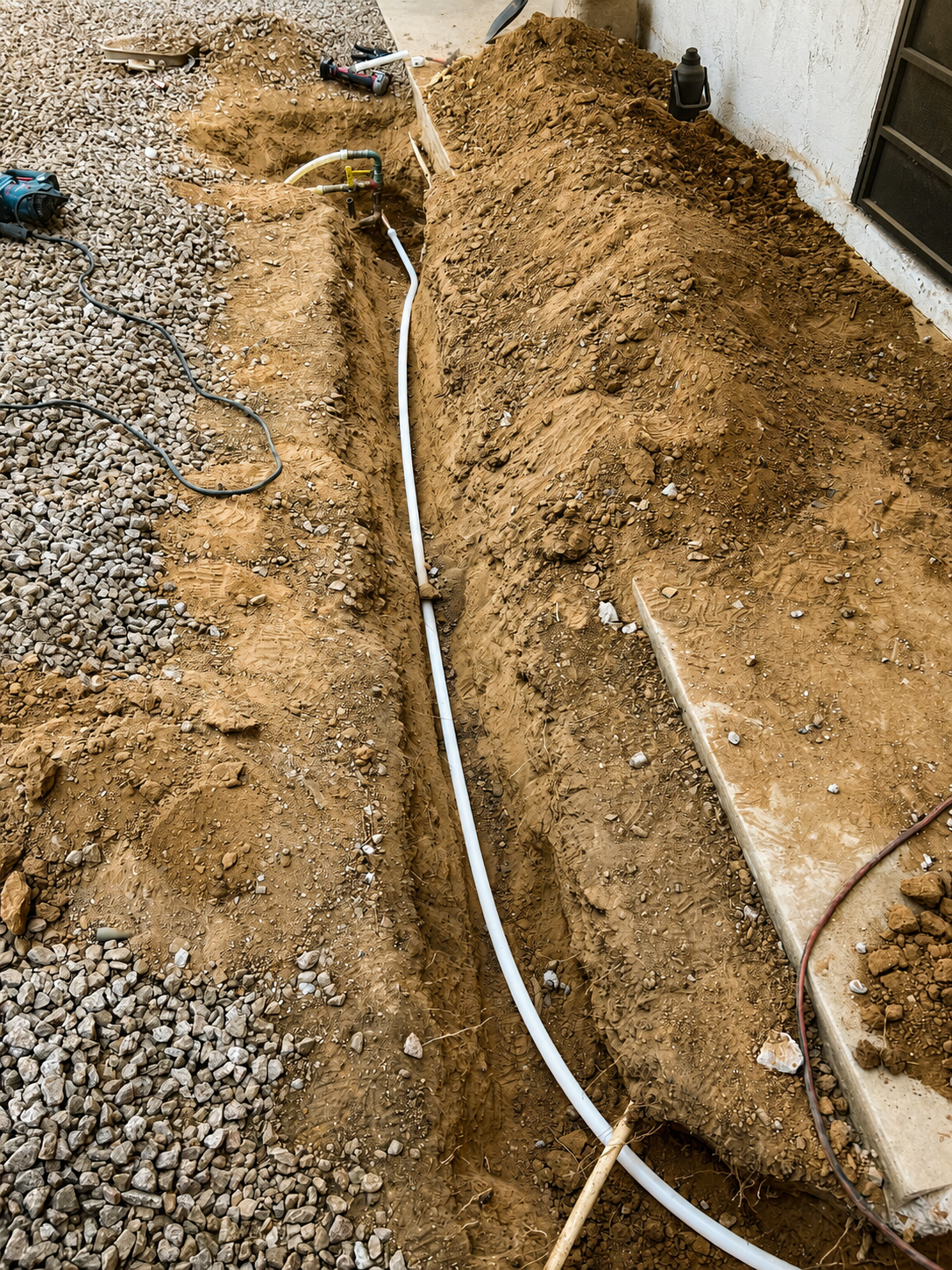
The first photo shows what the fix looked like from the outside. A clean trench dug alongside the building, a new flexible PEX line laid in and ready to be buried. The old copper was out. The new line was in. The trench would be backfilled, the interior connection remade, and the building would have a supply line that would not be a concern for a long time.
Cold water line replacement is one of those jobs that homeowners never think about until they have to. The pipe runs underground, it does not announce itself, and it works until it does not. When it stops working, it tends to make itself known in ways that are difficult to ignore.
What the Cold Water Line Actually Is and Where It Runs
Every home and building has a main cold water supply line that brings water from the meter at the street to the point where it enters the structure. That line runs underground for some portion of its length, typically from the meter box near the street or property line, through the yard, and into the building through the foundation, a wall penetration, or a utility room entry point.
Everything inside the home that uses water draws from that supply line. The water heater, every fixture, every appliance. It is the single pipe that the entire plumbing system depends on, and it spends its entire life buried in the ground or running through the first section of the building structure where most people never look at it.
In a Chandler home or building from the 1980s or 1990s, that supply line is likely original. It has been in the ground for 30 to 40 years, carrying hard mineral-heavy water the entire time, subject to the soil movement that comes with this area's expansive clay, and in some cases sharing that underground path with tree roots that have been growing toward the moisture it provides.
Why Copper Supply Lines Fail in Chandler Specifically
Copper was the standard material for residential supply lines for decades and it is a good material. In most conditions, copper holds up well for a long time. Chandler's water conditions are not most conditions.
The water here is very hard, loaded with calcium and magnesium that leave mineral deposits on every surface they contact. Inside a copper pipe, those minerals interact with the copper over years in a process that contributes to internal corrosion. The pipe wall thins from the inside. In hard water areas, copper supply lines develop pinhole leaks at a rate that softer water areas do not see, and the pinholes in a buried line do not show up as a visible drip. They show up as soil that is wetter than it should be, pressure that has dropped, or a bill that keeps climbing.
The soil chemistry in the East Valley also plays a role. Chlorides and sulfates in the soil attack the exterior of buried copper over time, and the same expansive clay that causes problems for foundations and buried drain lines causes movement that stresses the pipe at connection points and bends. The combination of water chemistry attacking from inside and soil chemistry attacking from outside shortens the practical lifespan of buried copper in this area compared to what the material would achieve in more neutral conditions.
The utility room in the second photo tells that story. The original copper supply connection at the point where the underground line enters the building showed the kind of corrosion and failure that comes from decades of those conditions. It was not one bad event. It was a long slow process that finally reached the point where the pipe could not hold what it was supposed to hold.
What the Replacement Process Looks Like
The job starts with locating the existing supply line and assessing what is happening. Pressure testing tells us whether water is escaping the system and helps isolate where the failure is occurring. For a line that is failing at the point where it enters the building, the scope is clear. For a line with failure along its underground run, the detection work tells us where to open the ground before anyone starts digging.
The trench in the first photo shows the replacement line laid in and ready. That is PEX, a flexible cross-linked polyethylene pipe that has become the standard for this kind of work. It handles temperature extremes well, does not corrode from Chandler water chemistry, does not react with soil conditions the way copper does, and its flexibility means it can be run in a continuous length with fewer fittings than rigid pipe requires. Fewer fittings means fewer potential failure points over the life of the installation.
The trench depth for a supply line in Arizona is determined by what provides adequate protection without the freeze depth requirements that colder climates need. The pipe goes in at proper depth, gets bedded correctly so it is not resting on rocks or debris that could stress the pipe wall over time, and then the trench gets backfilled and compacted in lifts rather than all at once, which prevents settling that could create a low spot in the line or put uneven pressure on the pipe.
Inside the building, the new line connects to the distribution system at the point where the old line terminated. Any interior section that showed deterioration at the entry point gets replaced at the same time. Pressure testing after the new line is in and connected confirms the system is holding correctly before the trench is closed and anything is restored.
When a Repair Is No Longer the Answer
A single pinhole leak in a buried copper supply line can be repaired. The pipe gets accessed, the failed section gets cut out and replaced, and the system is restored. That repair makes sense if the rest of the line is in good condition and the failure was an isolated event.
What we see more often in older Chandler properties is a pattern. One leak gets repaired, and six months or a year later there is another one at a different location on the same line. That pattern tells us the pipe material has reached the point in its degradation where multiple sections are vulnerable, not just the one that happened to fail first.
At that point, repairing individual sections is spending money to delay the replacement that is going to happen anyway. A full line replacement is a larger upfront cost than a single repair, but it solves the problem completely rather than buying intervals of time between the next failure. Homeowners who have been through two or three repairs on the same line over a few years almost always say the same thing when we talk about full replacement: they wish they had done it after the first one.
What to Watch For in Your Own Property
Pressure that has been declining gradually over months is one of the most consistent indicators of an aging supply line that is either scaling internally or developing small failures that are pulling pressure from the system. Not a sudden drop, just a shower that has felt a little weaker every few months until someone finally notices.
A water bill that keeps increasing without a clear explanation. Underground supply line leaks move water continuously. The bill shows it before the yard or the structure does in most cases.
Any visible moisture in a utility room or near the point where the supply line enters the building. A wet floor in that space, staining on the wall at the pipe entry, or any evidence of chronic moisture that does not have an obvious source.
For commercial properties and multi-unit buildings, the stakes are higher because a supply line failure affects everyone connected to it simultaneously. A proactive assessment of the supply line condition on an older commercial property is worth doing before the failure happens rather than after it is flooding a utility room during business hours.
We Handle Cold Water Line Replacement From the Meter to the Building
The full scope of this work, detection, excavation, new pipe installation, backfill, and interior connection, is something we handle as a single project. You do not need to coordinate multiple contractors or figure out who is responsible for which part of the job. We assess the situation, give you clear pricing before any work begins, and complete the installation through to a pressure-tested, functioning supply line.
If your property is more than 20 years old and you have been noticing any of the signs above, or if you have already dealt with one supply line repair and are wondering about the rest of the line, a call to discuss what an assessment would involve costs nothing.
Call us at 480-869-6952 or reach out online. We are in Chandler and handle cold water line replacement for residential and commercial properties. Pricing is always discussed before work begins.