This Is What Tree Roots Inside Your Sewer Line Actually Look Like. And Yes, It Happens Inside the House.
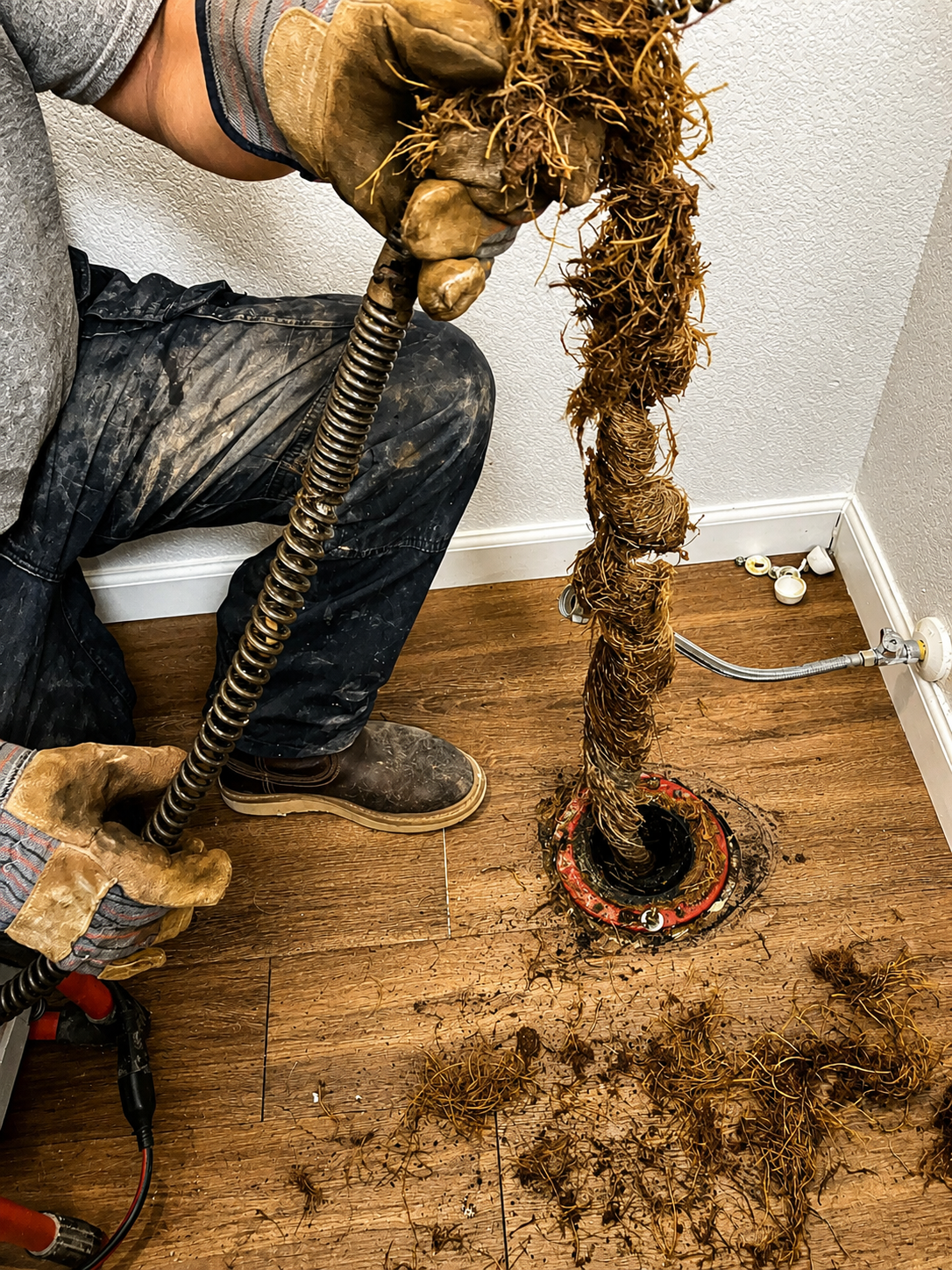
We pulled that out of a sewer line inside a Chandler home. The photos are from a job we did not long ago where a homeowner had been dealing with recurring slow drains and occasional backups for over a year. He had the line snaked twice by different plumbers. Each time it cleared. Each time it came back. Nobody had put a camera in to see what they were dealing with.
When we got there and ran the camera, the picture was obvious. Roots had worked their way into the line through a joint and had been growing in there, thriving actually, for what looked like years. When we pulled the snake out after clearing it, what came with it was what you see in the first photo. A dense mat of fibrous roots wrapped around the cable from end to end, pulled out through the cleanout access in the floor.
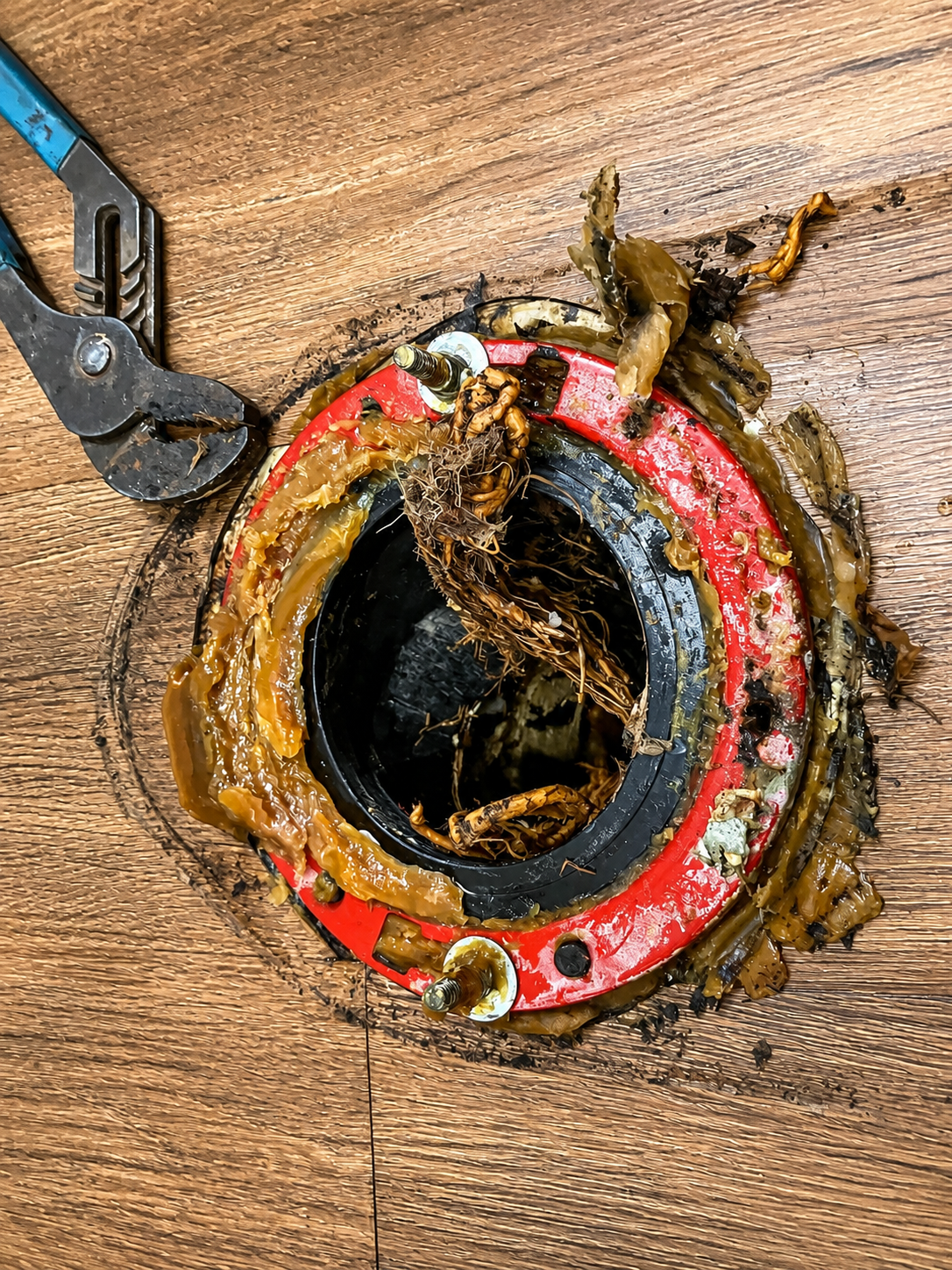
The second photo shows the flange and the pipe opening once the toilet was pulled and the area was exposed. Roots still visible inside the pipe, the wax seal long since compromised from whatever had been going on in that drain. This was not a small problem that developed overnight. This had been building for a long time while the homeowner kept calling for drain service and getting a temporary fix.
How Roots Get Into a Sewer Line in the First Place
Tree roots do not break into a pipe. They find openings that already exist. Every underground sewer line has joints, places where two pipe sections connect, and those joints are not perfectly sealed forever. Over years and decades, the ground shifts, pipes settle, and the seal at joints degrades. In clay pipe, which was common in older construction, joints were never airtight to begin with.
Roots are drawn toward moisture and warmth, and a sewer line under a yard offers both constantly. A root tip, which can be thinner than a human hair at the leading edge, finds a gap at a joint and pushes through. Inside the pipe it finds water, nutrients, and space. It grows toward both. What starts as a hairline intrusion becomes a tendril. The tendril branches. The branches grow thicker. Over a few years, a joint that had a minor gap has a root mass that is actively restricting the pipe.
In established Chandler neighborhoods with mature trees and landscaping that has been in the ground for twenty or thirty years, the root systems in the yard are extensive and actively seeking moisture sources. A sewer line running under that yard is one of the most reliable moisture sources available. We see root intrusion regularly in homes from the 1980s and 1990s in this area. It is not a sign that something was done wrong. It is what happens when aging pipe runs beneath mature landscaping for long enough.
Why Snaking Alone Does Not Solve It
A drain snake is a cable with a cutting head that punches through or cuts back whatever is blocking the pipe. For a root intrusion, it removes enough of the root mass to restore flow. The drain works again. The homeowner is relieved. Three to six months later, the drain is slow again.
The reason it comes back is that snaking does not remove the root. It cuts it back. The root that was growing through the joint is still anchored to the joint. The tip that was cut off keeps growing back from the remaining tissue inside the pipe. Roots that have been cut once tend to grow back denser than they were before because the plant responds to the cut by sending more growth toward the moisture source.
We have been on jobs where a homeowner has had the same line snaked four or five times over two years and every plumber who came out before us treated it as a simple blockage. Nobody ever put a camera in to see that there were roots actively growing in the line. The snaking gave relief each time and that relief prevented the urgency that would have led to a proper diagnosis sooner.
The homeowner in the photos above had the same experience. Two snaking visits, two temporary fixes, and then us. What we showed him on the camera was something neither of the previous plumbers had looked for. Once he saw the footage, the two years of recurring problems made sense immediately.
What the Repair Actually Looks Like
Clearing root intrusion properly starts with the camera. We need to see where in the line the roots have entered, how extensive the growth is, and what condition the pipe is in at the joint where the intrusion happened. That information determines what the repair involves.
If the intrusion is relatively contained and the pipe itself is structurally sound, hydrojetting after the initial clearing can strip the remaining root material from the pipe walls more completely than snaking alone. High-pressure water hits the walls from multiple angles and clears the debris that a snake cable leaves behind. The line flows better after a proper hydrojet than after a snake job, and the roots take longer to grow back to the point of causing a problem again.
If the camera shows that the joint where roots entered is significantly damaged or that the pipe has shifted or cracked, pipe lining is worth discussing. A liner inserted through the existing pipe and cured in place creates a new sealed interior surface that covers the compromised joint. Roots cannot push through a properly installed liner the way they can through a deteriorated original joint. It does not require digging up the yard or cutting through concrete. The repair happens from inside the pipe.
If the pipe damage is extensive, or if there are multiple points of entry and the pipe material is past the point where lining makes sense, we talk about what full replacement of that section would involve. That is the conversation nobody wants to have, but it is better to have it based on actual camera footage than to keep snaking a line that has a structural problem underneath the root issue.
The Flange and Wax Seal Situation
The second photo shows something that comes up on root intrusion jobs more than people expect. The toilet flange and the wax seal. When roots have been growing in a sewer line for years, the movement and pressure in the line affects the connections at every fixture attached to it. The wax seal at the toilet base is not designed to withstand the kind of stress that comes from a root-clogged line backing up repeatedly.
In the job pictured, the flange showed visible deterioration and the wax seal was well past its functional life by the time we got there. The toilet had been sitting on a compromised seal, which means sewage gas had potential pathways into the room and moisture had been able to reach the floor structure beneath the toilet with every use.
Any time we pull a toilet as part of a root intrusion job, we inspect the flange, replace the wax ring, and confirm the floor around the base has not taken on moisture damage that needs to be addressed before the toilet goes back. Putting a toilet back on a deteriorated flange or a failed wax ring is not a finished job.
If Your Sewer Line Has Never Been Looked At
Most homeowners in Chandler who live in houses built in the 1980s or 1990s have never had a camera run through their main sewer line. The line has been working, mostly, and there was no obvious reason to look. That is a completely understandable position. It is also why we find what we find when we do finally get a camera in there.
Root intrusion that has been developing for five or seven years before anyone runs a camera does not look like what it looked like at year one. The mass we pulled out in the first photo took years to get to that size. At year one or two, a camera inspection would have shown early intrusion at a joint and the options for addressing it would have been more and less expensive than what that homeowner ended up facing.
We are currently offering 10% off drain cleaning services, which includes camera inspection and clearing for root intrusion. If you have mature trees in the yard and your home is more than twenty years old and the sewer line has never been inspected, that is a combination that is worth looking at.
Call us at 480-869-6952 or reach out online. We are in Chandler, we run a camera before recommending any repair scope, and we show you what we find before discussing what to do about it. Pricing is always upfront.