
A.O. Smith vs Rheem: Which Is Better?
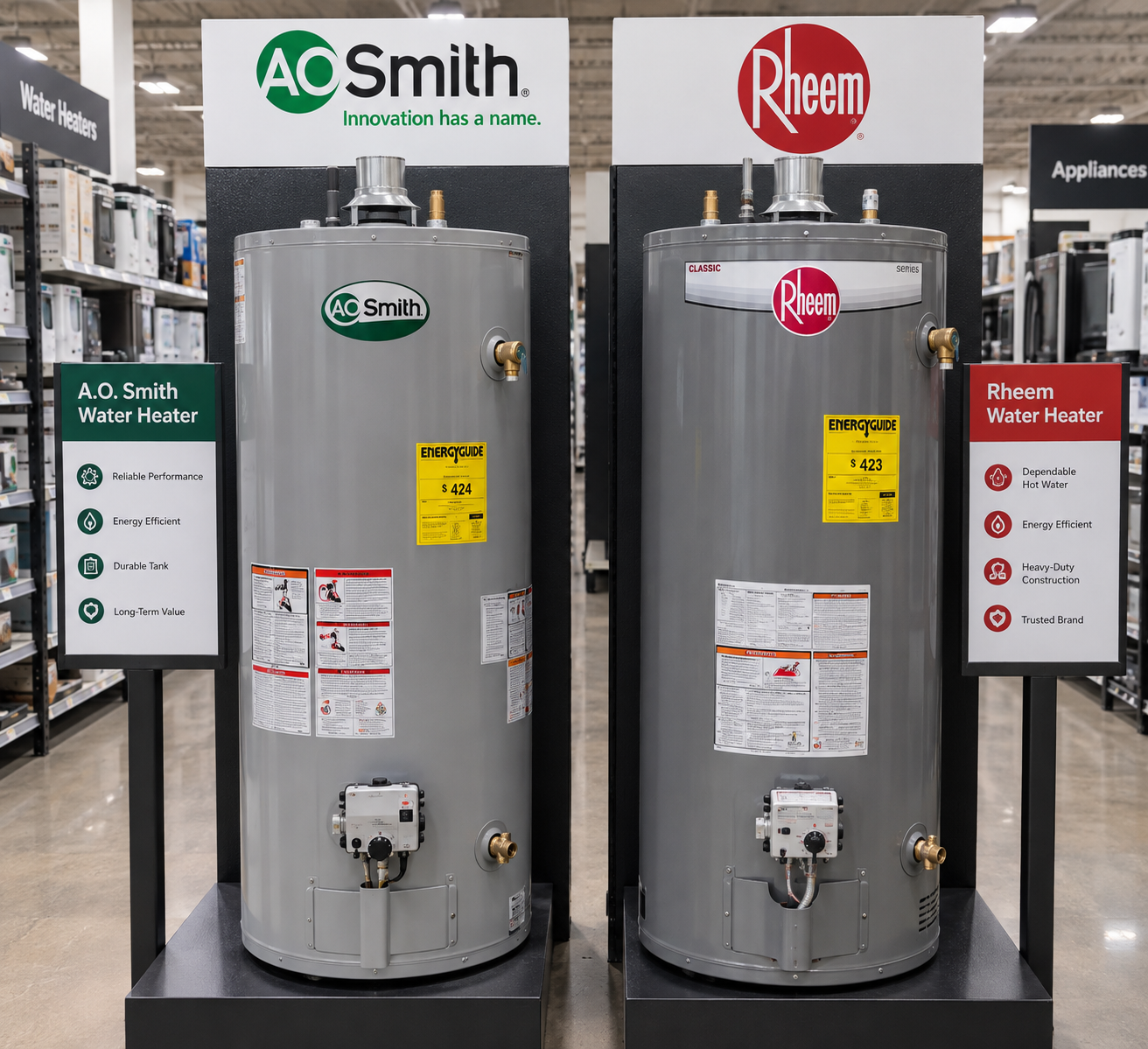
A.O. Smith and Rheem are both worth considering, but neither should win your purchase on name alone. The better choice is the specific water heater that meets your household’s demand, fits your installation space, and offers a sensible total cost. This comparison explains what to check, where meaningful differences appear, and how to choose without paying for features you do not need.
Which is better: A.O. Smith or Rheem?
For an A.O. Smith vs Rheem water heater comparison, the most useful verdict is conditional: choose the model with suitable hot-water delivery, lower ownership costs, and dependable local service. Do not assume that one manufacturer’s premium model represents its entire range. Both offer different product types and feature levels, so compare equivalent units rather than a basic tank against an upgraded system. Their residential ranges include conventional storage and heat-pump options. (hotwater.com)
My recommendation is to give installation fit and service support more weight than small feature differences. Ask each installer to explain why the proposed model suits your busiest hot-water period and who would handle a repair.
Use this starting point:
Replacing a failed heater: Prioritize a compatible model and a complete installation quote.
Reducing electricity use: Compare appropriately sized heat-pump models.
Planning a renovation: Evaluate different heater types before choosing the manufacturer.
Start with the type of water heater
The technology determines how the heater works; the brand determines the particular choices within that category. Storage heaters keep heated water in a tank, tankless heaters warm water as it flows through, and heat-pump heaters transfer heat to the water. Choosing between those approaches is a more fundamental decision than choosing a logo. (energy.gov)
Conventional storage tanks
A conventional gas or electric tank deserves a place on your shortlist when you want a familiar storage-based system. However, matching the old tank’s gallon capacity is not enough. Compare its first-hour rating, which indicates how much hot water it can deliver during an hour that starts with a fully heated tank. That makes it useful for judging morning showers and other concentrated demand. (basc.pnnl.gov)
Heat-pump water heaters
Heat-pump models are worth examining when replacing a conventional electric heater because they can use substantially less electricity. Installation conditions still matter: the unit needs appropriate airflow, clearances, and drainage. Fans and compressors also produce sound, so discuss placement before putting one beside a bedroom or quiet living space. (energy.gov)
Tankless water heaters
Tankless systems heat water on demand, but continuous heating does not mean unlimited simultaneous output. Have the installer size the system for the fixtures you may run together and the temperature increase your incoming water requires. A household taking consecutive showers presents a different challenge from one running several showers at once. (basc.pnnl.gov)
Which water heater costs less to own?
Neither brand can be called cheaper without comparing exact models and installation quotes. Evaluate the equipment price, required installation work, estimated energy use, and maintenance together. Equipment and installation costs vary by location, while the existing setup can affect what work is necessary. A lower purchase price is therefore only one part of the decision.
Request itemized quotes rather than a single unexplained total. Ask whether each quote includes removal of the old heater, permits, required connection changes, and any accessories needed for the proposed installation. Treat missing items as unanswered questions, not automatic savings.
For a planned upgrade, ask for two alternatives: a straightforward replacement and a more efficient option. Then request an estimate of annual operating costs using your household’s usage and local energy prices. Compare those assumptions carefully; a savings estimate based on another household is not a promise about your bill.
If your replacement is urgent, decide how much extra you are willing to spend to change technologies. That keeps a necessary purchase from turning into an unplanned renovation.
Compare efficiency without getting lost in specifications
Look for the Uniform Energy Factor, usually shortened to UEF. Higher values indicate greater efficiency, but UEF is not a dollar figure. ENERGY STAR also uses efficiency criteria to identify qualifying water heaters, making certification a useful screening tool rather than a substitute for comparing individual models.
Next, check hot-water delivery. For storage models, use the first-hour rating alongside tank capacity. An efficient heater still needs to cover your busiest period; selecting a tank solely because its advertised energy use looks low misses that practical requirement.
With heat-pump models, discuss operating modes as well. Backup electric heating can help satisfy higher demand, but it uses more energy than heat-pump operation. Appropriate sizing can reduce reliance on that backup, so the smallest available tank is not automatically the most economical choice.
A useful installer question is: “Will this model meet our normal demand while operating efficiently?” Ask for an explanation tied to your shower schedule, not just the number of people in the home.
Which brand is more reliable?
This comparison does not establish a brand-wide reliability winner. Product specifications and warranty lengths do not, by themselves, show how frequently comparable heaters fail. Rather than treating reputation as proof, evaluate the exact model, its maintenance requirements, and the practical service arrangements available to you.
Start with the warranty certificate for the proposed unit. Tank coverage, parts coverage, labor, and replacement-related expenses should be checked separately. For example, an A.O. Smith residential gas warranty excludes labor charges for service, removal, and reinstallation; Rheem directs owners to model-specific warranty information and service support. Do not assume every cost is covered because a heater has a long advertised warranty. (assets.hotwater.com)
Before buying, ask:
Who diagnoses a problem and submits the warranty claim?
What labor or service-call charges could remain payable?
Are common replacement parts stocked locally?
What maintenance does this exact model require?
Which receipts and installation records should you retain?
Request written answers where possible. A clearly explained service process is more useful to your purchase decision than an unsupported promise that one brand “never breaks.”
Smart features deserve a closer look
Features can create a meaningful difference between two otherwise suitable models. For example, Rheem lists LeakGuard leak detection and prevention on a ProTerra Performance Platinum heat-pump model. A.O. Smith describes integrated leak detection and connected controls on Voltex AL models, with an optional shutoff valve accessory. That distinction makes it important to confirm what comes with the quoted unit. (rheem.com)
Ask whether a feature merely sends an alert or also shuts off the incoming water. Confirm whether the necessary valve is included, whether connectivity is required for notifications, and who sets everything up.
If you are considering a Rheem water heater because of its smart controls, compare those functions with the specific A.O. Smith alternative—not with the brand’s whole catalog. Also ask yourself whether you will use scheduling or remote controls. A feature should solve a household problem, not simply make the specification sheet longer.
A practical checklist for comparing quotes
Once you have narrowed the options, put the proposals side by side. Ask both installers to quote the same heater category and explain any differences in capacity, delivery, or features. This makes the price comparison easier to interpret.
Use the following checklist before accepting either proposal:
Confirm the model number. Request the specification sheet and warranty certificate for the exact unit being supplied.
Describe your busiest hour. Explain overlapping showers, laundry, and other hot-water use so the recommendation reflects your routine.
Check the proposed location. Ask the installer to verify dimensions, service access, and installation requirements before ordering.
Separate included work from possible extras. Request a written list of exclusions and circumstances that could change the price.
Compare ongoing responsibilities. Ask for the maintenance schedule, expected service arrangements, and warranty-claim contact.
Request a handover. Have the installer explain normal controls, useful operating modes, and what to do if an alert appears.
If one quote is considerably cheaper, ask what accounts for the difference. If one is more expensive, ask which benefits justify the premium. You should be able to explain your choice without relying on the brand name alone.
The bottom line
The best water heater is the one that fits your home and performs the job you need at an acceptable ownership cost. Keep both A.O. Smith and Rheem on the shortlist, then let comparable specifications, complete quotes, and clear service terms guide the decision. Choose the better-supported proposal—not an assumed brand-wide winner.
