
Can a Leaking Water Line Cause Soil Erosion Beneath Pavement?
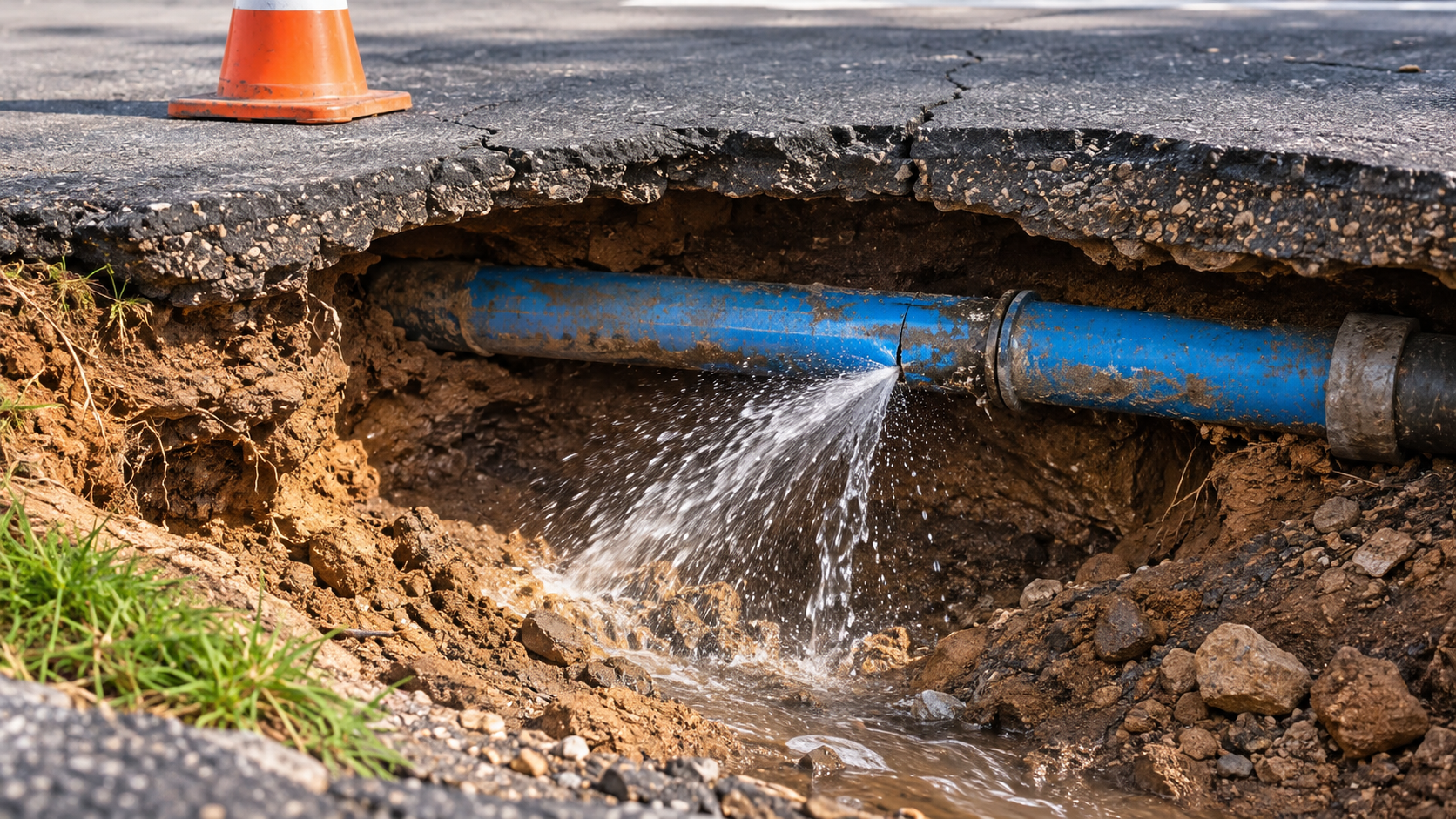
Yes—a leaking water line can cause soil erosion beneath pavement, leaving a driveway, sidewalk, or patio without dependable support. Escaping water can carry away fine soil particles or saturate the ground until it becomes weaker, allowing the surface above to settle or crack. The important distinction is that repairing the pipe stops the water, while restoring the pavement may also require repairing what happened underneath it.
A persistent wet patch deserves attention, especially when it appears alongside changing pavement levels. Here’s how to recognize the warning signs, investigate safely, and discuss a repair that addresses more than the visible damage.
How does a leaking water line undermine pavement?
A leaking water line can undermine pavement when escaping water moves soil particles away from the supporting layers or weakens those layers through saturation. As support becomes uneven, the pavement must bridge areas that no longer carry weight properly. Traffic can then contribute to further movement, cracking, and deterioration.
Think of pavement as the top of a supporting system, not a freestanding cover. Its condition depends partly on the soil and base material beneath it. Even a surface that initially looks intact can have developing voids below; federal pavement guidance describes how those voids can enlarge until a concrete slab loses support and breaks.
Two related problems are worth separating:
Erosion: Moving water carries fine particles away, potentially leaving gaps beneath the pavement.
Saturation: Water remains within the ground, reducing its ability to support loads even without an obvious empty cavity.
Both can damage pavement, but they are not interchangeable diagnoses. Wet ground alone does not tell you how much material has disappeared—or whether any has disappeared at all. An assessment needs to distinguish weakened ground from actual loss of supporting material.
What signs suggest a leak beneath pavement?
Persistent dampness, unexplained water use, and new pavement depressions can suggest an underground leak, particularly when they occur together. None proves that a water line is responsible on its own. Utilities identify wet spots, small holes, depressions, and paving cracks as reasons to investigate hidden leakage.
Watch for these patterns:
Wet pavement during dry weather: Note whether the area stays damp when nearby surfaces have dried.
A new low spot: Record changes in a driveway, walkway, or paved area rather than assuming they have always been there.
Unusually green growth nearby: A concentrated patch of vigorous grass can accompany underground leakage.
Higher water use without an explanation: Compare bills with similar periods and account for irrigation or household changes.
Water movement through the meter when everything is off: This can indicate leakage somewhere downstream of the meter, although it does not locate the problem beneath pavement.
The location of visible water can also be misleading. Fairfax County’s soil and water conservation guidance notes that water from a buried leaking pipe may travel underground before reaching the surface. That means a puddle beside your driveway is a clue—not a reliable excavation target.
Photograph the area from a safe position and note the weather, irrigation schedule, and when you first noticed changes. Share those observations with whoever investigates. A clear timeline is more useful than guessing whether the problem started directly beneath the newest crack.
First steps: protect the area and check for unexplained flow
Treat a new depression or opening as a reason to keep people and vehicles away, not an invitation to test its strength. Pavement can lose support as voids develop beneath it. Avoid parking over the suspect area or walking onto it for a closer photograph.
Use this practical sequence:
Restrict access. Keep children, pets, visitors, and vehicles clear of visibly affected pavement. Do not stand on the damaged section to place a barrier.
Report active leakage. Contact your water utility about water emerging from a street, sidewalk, or suspected public supply line. For a suspected private-line problem, contact a qualified plumbing professional; ask the utility if responsibility is unclear.
Check the meter only if it is safely accessible. Turn off water-using fixtures, irrigation, and appliances, then follow your utility’s instructions for observing the meter.
Record rather than disturb. Save photographs, meter readings, and relevant water bills. Avoid opening the pavement yourself.
The EPA recommends comparing meter readings over a two-hour period when no water is being used. A changed reading suggests a leak, but the result does not establish which pipe is leaking or whether pavement has been undermined. Give the findings to the investigator rather than treating the test as a complete diagnosis.
Before excavation, contact 811 and follow your state’s utility-location process. Ask whether private lines need a separate locator, too; public utility marking does not necessarily cover every buried line on a property. Do not treat a suspected leak as a reason to skip this step.
Professional Leak Detection narrows down the source
Professional leak detection helps establish where water is escaping before repair access is planned. Depending on the situation, specialists may use listening equipment, acoustic sensors, flow monitoring, or other locating methods. These tools help investigate hidden leakage rather than relying solely on where moisture appears above ground.
Ask the investigator to explain three separate findings: whether there is an active leak, where the likely leak is located, and what remains unknown about the surrounding ground. Keeping those questions separate helps you understand the scope of the proposed work. A pipe-location finding should not be presented as a complete assessment of pavement support.
Also ask what happens if the exposed conditions differ from the initial findings. Will the contractor pause and document additional damage? Who will assess any larger cavity or affected adjoining pavement? Clarifying that process before work begins makes it easier to compare proposals without relying on vague promises.
Repair the pipe and the pavement’s support
A lasting repair needs to address both the water source and the condition of the supporting layers. Federal pavement restoration guidance treats utility repair, backfilling, compaction, and surface replacement as distinct stages. Simply covering the opening is not the same as restoring the pavement system.
A written proposal should explain the expected sequence:
Stop the leak: Identify the pipe repair or replacement included in the work.
Assess the exposed ground: Explain how missing material, unstable soil, and the extent of affected support will be evaluated.
Restore the base: Specify suitable backfill and the planned compaction or engineered filling method.
Restore the surface: Identify the pavement area included, finishing work, and conditions for reopening it to traffic.
Document changes: State how additional findings will be communicated and approved.
Concrete slab stabilization is sometimes used to fill voids beneath pavement, but it is a specific treatment—not a substitute for investigating the water source. Ask why the proposed approach suits the actual damage rather than assuming every sunken area needs the same repair.
Choose water damage solutions that address the cause
Useful water damage solutions should distinguish plumbing repairs from drainage improvements and pavement restoration. Groundwater, surface infiltration, and leaking pipes are different possible sources of moisture. Erosion control measures should therefore respond to the identified pathway, rather than being added as a generic cure for every wet or sinking area.
How Umbrella Plumbing can resolve a leak-under-pavement problem
If a water line leak is suspected under a driveway, walkway, patio, or slab, Umbrella Plumbing can help by approaching the job in two parts: locating the leak accurately, then repairing the line in a way that limits disruption and supports proper restoration.
Leak Detection and confirmation: Identify whether there’s an active leak, narrow down its location, and document findings so you’re not opening pavement based on guesswork.
Water line repair or replacement: Repair the damaged section or recommend replacement when the line condition suggests recurring failure risk.
Shutoff and damage control: Help isolate the water source quickly to reduce ongoing saturation and erosion beneath the pavement.
Coordination for restoration: Explain what a complete fix usually requires beyond plumbing—such as proper backfill/compaction and surface restoration—and coordinate with (or recommend) the right trade when pavement repair is needed.
Next-step prevention: Share practical steps to reduce repeat issues, such as monitoring for unexplained usage and addressing drainage conditions that keep soil saturated.
When you call Umbrella Plumbing—the trusted name everyone calls—ask for a clear scope that separates plumbing work from any concrete/asphalt work, plus what will be verified after the repair (for example, pressure testing or confirming water use returns to normal).
The takeaway: look below the surface
Leaking water lines can erode or weaken the ground beneath pavement, but a crack or puddle alone cannot establish the cause. Keep the affected area clear, investigate unexplained water flow, and arrange an assessment before committing to surface repairs. The goal is straightforward: stop the leak, restore dependable support, and then repair the pavement above it.
